.svg "DELMIC")
@2x(1).png?width=132&height=36&name=Delmic_Black+Blue(preferred)@2x(1).png "Delmic_Black+Blue(preferred)@2x(1)")


.png)


Large-scale volume electron microscopy (vEM) is transforming biological research by making it possible to image cells and tissues in 3D at nanoscale resolution. This combination of scale and detail allows researchers to study biology in its native context and uncover structures that are difficult or impossible to detect with conventional imaging.
On 27 February 2026, we hosted a webinars session featuring three experts in the field - Dr Carolyn Ott from Janelia Research Campus, Dr Vito Mennella from Queen Mary University of London, and Dr Nalan Liv from University Medical Center Utrecht. The webinars and panel discussion highlighted how 3D atlases are being used to uncover structural features, cellular transitions, and organelle organization that are difficult or impossible to capture with conventional 2D imaging. The examples discussed span the brain, developing cerebellum, human airway epithelium, and cancer organoid models, illustrating both the biological utility of nanoscale imaging and the importance of large-scale data acquisition. The talks demonstrated that large-scale Volume EM is not just an imaging method — it is a discovery platform.
But now, in an unbiased way, we could visualize hundreds of cells and then pull the data together.
That's very powerful ... the data becomes hypothesis driving rather than hypothesis driven at one point, because the more that you look at these things, I start to pose also more questions.Dr Nalan Liv, University Medical Center Utrecht
Why 3D cell and tissue atlases matter
1. It reveals rare and hidden structures
Many biologically important features - such as cilia, organelle contacts, and transitional cell states - are too small, too rare, or too deeply embedded in tissue to be captured reliably with standard methods. Large-scale vEM makes these structures visible across many cells and regions.
2. It provides true 3D context
Unlike 2D section imaging, vEM reconstructs cells and tissues in three dimensions. This is essential for understanding how organelles are arranged, how cells interact, and how structure relates to function.
3. It enables quantitative biology
With large datasets, researchers can move beyond visual observation and measure cell morphology, organelle size, spatial organization, and cell-state differences across tissues and disease models.
4. It supports discovery-driven research
Because it captures so much detail across so much tissue, Volume EM often reveals unexpected biology — including rare intermediates, structural diversity, and new cell-state transitions that were not anticipated beforehand.
... discovery motivated science is different than hypothesis-driven projects. However, it's not a fishing expedition. Discovery motivated science involves information. Rich data where anything that someone finds can be informative, you do need prior knowledge to maximize what you can learn in these data sets, and these observations generally lead to new hypotheses.
Dr Carolyn Ott
Examples of what 3D cell and tissue atlases enable
In the webinars, large-scale vEM was used to:
- identify rare cilia and their structural variants in brain tissue
- capture multiple stages of cilia disassembly during cerebellar development
- build a single-cell atlas of the airway epithelium
- reveal organelle remodeling and contact-site changes in cancer models
A powerful platform for biological discovery
By combining nanoscale resolution with large imaging volumes, Volume EM gives researchers a powerful way to study tissues as they really are: complex, spatially organized, and dynamic. It is helping define new biological insights that would not be accessible through conventional imaging alone.
Watch the webinars session recording on the vEM Community YouTube channel:
References and acknowledgment
Ott et al (2024) Permanent deconstruction of intracellular primary cilia in differentiating granule cell neurons, J Cell Bio 223(10):e202404038
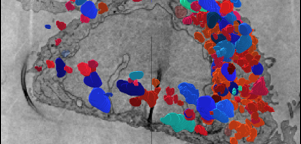
Banner image courtesy of Lakshmi Edakkandiyil, Dr Nalan Liv Group, UMC Utrecht, The Netherlands